
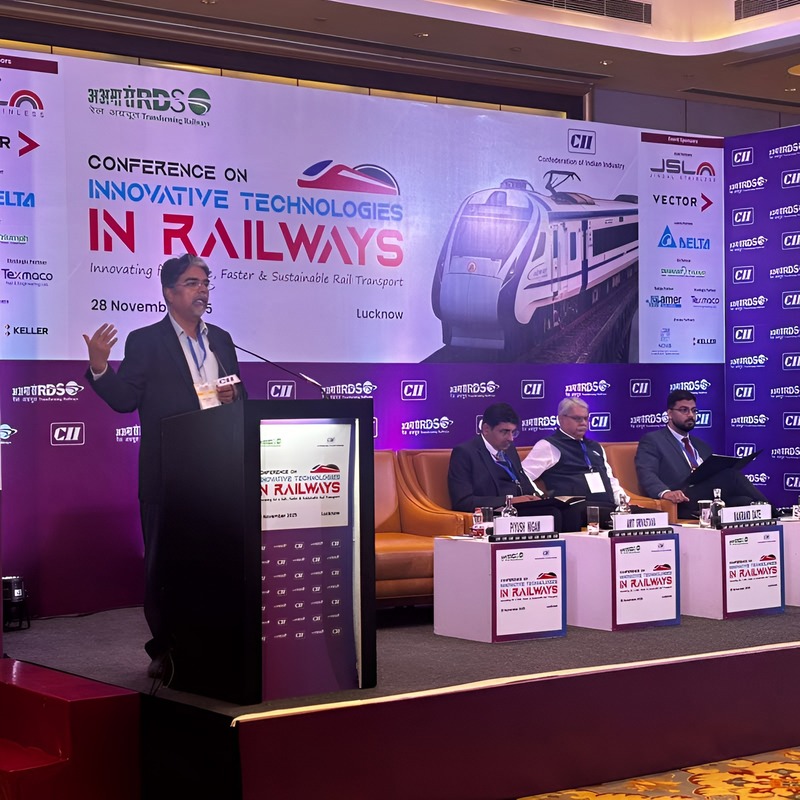
Confederation of Indian Industry (CII) and Research Designs & Standards Organisation (RDSO) organized a Conference on Innovative Technologies in Railways in Lucknow. The conference brought industry leaders, technology experts, and key stakeholders together, with an aim to explore emerging technologies and new possibilities in India’s rapidly evolving railway ecosystem.
Piyush Nigam, CEO of IntelliRail, spoke about key innovations that can take safety, operational efficiency, and cost effectiveness of the railways to the next level.
A Momentous Event
 Event: Conference on Innovative Technologies in Railways
Organized by: The Confederation of Indian Industry (CII) and Research Designs & Standards Organisation (RDSO)
Held on: November 28, 2025
Held at: Lucknow
Underlying Theme: Innovating for a Safe, Faster & Sustainable Rail Transport
Key Focus Areas:
- Enhancing Speed & Throughput of Indian Railways
- Emerging Opportunities in the Railway Value Chain
- Condition-Based Maintenance of Railway Assets
The event was an excellent opportunity for industry experts, thought leaders, and disruptors to come together to exchange knowledge and discuss ideas to build the future roadmap for the Indian Railways.
 The event provided the perfect platform to explore advanced technologies, innovations, and strategic collaborations that could help the Indian Railways play a crucial role in achieving the objective of a Vikasit Bharat by 2047.
Among the fundamental pillars of Vikasit Bharat is formed by entrepreneurs who are committed to “Make in India.” IntelliRail’s CEO Piyush Nigam is among such companies. He spoke on AI-Driven Machine Vision Monitoring of Railway Assets, which plays a key role in condition-based maintenance.
Why Condition-Based Maintenance Has Become a Focus Area
Rail accidents cost India over ₹2,000 crore annually. But the impact goes much beyond the financial hit. The cost of injury and death is immense. Plus, accidents lead to operational disruptions, with trains being rerouted and delayed. This leads to monetary loss as well as lost opportunities for people travelling for a specific purpose.
The shift to condition-based monitoring and maintenance powers railways to proactively repair and replace defective train and track components. This significantly reduces the risk of accidents, while also lowering the cost of maintenance.
During his talk, Piyush highlighted that condition-based monitoring and predictive maintenance can bring the total cost of maintenance down by as much as 45%, compared to time-based maintenance. In addition, pre-maintenance inspection time is reduced, and asset availability rises by up to 30%.
Research across industries, including the railways, has long proven that switching from manual to automated monitoring and condition-based maintenance (CBM) improves efficiency and safety while reducing costs. According to a McKinsey report, condition-based maintenance helps reduce manual diagnostic time by at least 60%. Moreover, the maintenance team knows exactly which spare parts and equipment are needed even before the train or track is commissioned for maintenance. This significantly decreases the time the asset is unavailable for operations.
When Machine Vision Comes Together with Edge Computing and AI
IntelliRail’s CEO demonstrated how using advanced technologies, like machine vision, edge computing and AI-powered data analytics, maximizes accuracy and speed of condition-based monitoring. These technologies power two of IntelliRail’s key offerings.
IntelliWPMS
The company’s Automated Wheel Profile Measurement System (AWPMS) uses a combination of these technologies, along with powerful camera and laser setups, to monitor wheel parameters, such as flange height, flange thickness, wheel diameter, back-to-back gauge, and more. Clear, high-resolution images are captured using laser triangulation and machine vision for trains moving at speeds of up to 120 kmph.
Edge computing ensures that the images are sorted for relevance and quality in real-time and only those that meet the criteria are transmitted to the Cloud (IntelliCloud) for further processing and analysis. Concerned personnel can then access graphical representations of the wheel parameters within minutes of a train passing through the AWPMS.
IntelliRail’s AWPMS has been successfully installed for Mumbai Metro at Charkop Depot. This is the first “Make in India” wheel profile measurement system t The company has also been selected to install the wayside wheel profile measurement system for Chennai Metro.
IntelliScope
This product optimizes the maintenance of the rail head (top of the railway track). IntelliScope uses machine vision to capture high-quality images of the rail head with powerful P67-rated cameras and P69-rated laser lights. With this, images can be captured even while the rail inspection vehicle or train is in motion.
The images are processed and optimized with edge computing and transmitted to IntelliCloud in real-time. Here, AI software is trained to recognize defects, making relevant images available for viewing within minutes. Personnel at the inspection center can check the image directly on a web-based interface. They can download the reports and share them with the track grinding team.
Participating in the Vikasit Bharat Agenda
IntelliRail has carefully designed its systems to withstand harsh weather conditions and require minimal or no civil work. The use of machine vision, edge computing, and AI eliminates human dependency and the risk of human error. Data-driven decision-making becomes easier when deviations or defects can be seen at a glance. This increases asset availability, operational efficiency and cost saving.